Презентация - "Мультимедийное сопровождение практического занятия по теме "Традиции питания в Великобритании""
- Презентации / Другие презентации
- 0
- 04.09.25
Просмотреть и скачать презентацию на тему "Мультимедийное сопровождение практического занятия по теме "Традиции питания в Великобритании""
Сайт klass-uchebnik.com предлагает качественные учебные материалы для школьников, родителей и учителей. Здесь можно бесплатно читать и скачивать современные учебники, рабочие тетради, а также наглядные презентации по всем предметам школьной программы. Материалы распределены по классам и темам, что делает поиск максимально удобным. Каждое пособие отличается логичной структурой, доступной подачей материала и соответствует действующим образовательным стандартам. Благодаря простому языку, наглядным схемам и практическим заданиям, обучение становится легче и эффективнее. Учебники подойдут как для ежедневной подготовки к урокам, так и для систематического повторения перед экзаменами.
Особое внимание стоит уделить разделу с презентациями - они становятся отличным визуальным дополнением к теории, помогают лучше понять сложные темы и удерживают внимание учащихся. Такие материалы удобно использовать в классе на интерактивной доске или при самостоятельной подготовке дома. Все размещённые на платформе материалы проверены на актуальность и соответствие учебной программе. Это делает сайт надёжным помощником в образовательном процессе для всех участников: школьников, учителей и родителей. Особенно удобно, что всё доступно онлайн без регистрации и в свободном доступе.
Если вы ищете надежный источник для подготовки к урокам, контрольным и экзаменам - klass-uchebnik.com станет отличным выбором. Здесь вы найдёте всё необходимое, включая "Мультимедийное сопровождение практического занятия по теме "Традиции питания в Великобритании"", чтобы сделать обучение более организованным, интересным и результативным.

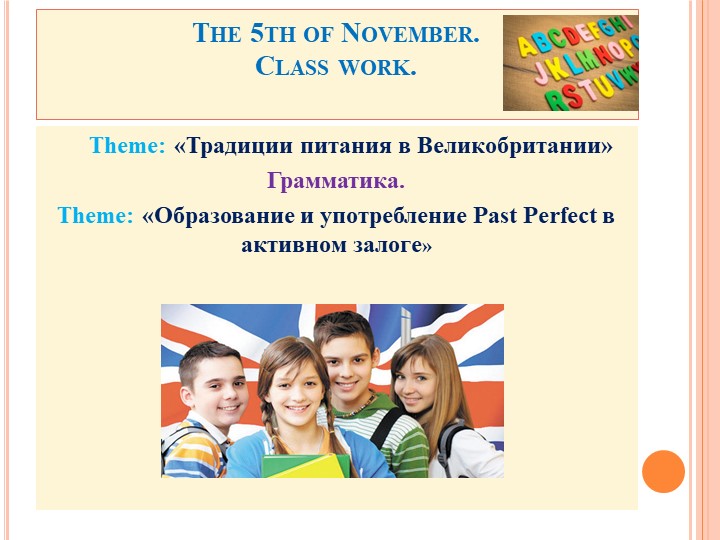
The 5th of November.
Class work.
Theme: «Традиции питания в Великобритании»
Грамматика.
Theme: «Образование и употребление Past Perfect в активном залоге»

Грамматика. «Образование и употребление Past Perfect в активном залоге»
Работаем по учебнику Безкоровайная стр.143-146.
Прочитать и выучить правило.
Выполните упражнение 11.1. на стр. 145-146 письменно в тетради.


PRACTICE
11.1. Put the verbs in the Past Perfect tense.
1. Suddenly Peter remembered he__(forget) her key at home,
but then he found it in his case.
2. Sveta wasn't at home when her Granny came back. She_
(go) out to do shopping before.
3. I saw an urgent message on the table. Somebody_(leave) it
for me the day before.
4. I wasn't hungry because I_(just/have) breakfast.
5. Paul apologized he_(not/phone) his friend.
6. He told me that Anna__(come back) three days before.
7. She knew him at once though she_(meet) him many years
before.
8. They couldn't believe Mark_(give up) his job in the bank. 9. Her Mother said that she__( already/buy) everything for
their trip to the sea.
10. They_(finish) cleaning the room by two o'clock.
11. We had no car at that time because we__(sell) our old one.

«Традиции питания в Великобритании»
Работаем по учебнику Безкоровайная стр.94-96.
Работа со словами стр.94-95: прочитайте и выпишите слова в тетрадь, найдите к ним транскрипцию в словаре. Выучите слова.
Работа с текстом стр.95-96: прочитайте и переведите текст “MEALS”. Выполните задания к тексту №6.3 и 6.4 на стр.96 письменно.
Домашняя работа: прочитайте и переведите текст из раздаточного материала задание 6.13 «Еда в Великобритании».

PRONUNCIATION
Repeat the proverbs after the teacher.
Eat with pleasure, drink with measure. - Ешь вволю, а пей в меру.
Live not to eat, but eat to live. - Живи не для того, чтобы есть, а ешь для того, чтобы жить.
You cannot make an omelet without breaking eggs. - Невозможно сделать омлет, не разбив яиц.

Useful Vocabulary
Study the following words and word combinations:
1) to cook - готовить еду;
2) to roast - жарить;
3) to stew - тушить;
4) vinigar - уксус;
5) mustard - горчица;
6) porridge - каша;
7) corn flakes - хлопья;
8) tasteless - безвкусный;
9) mutton chop - баранья котлета;
10) sweet - сладкий;
11) sour - кислый;
12) substantial meal - существенная еда;
13) pudding - пудинг;
14) midday meal - дневная еда.

Текст «MEALS»
When we cook, we boil, roast, fry or stew our food. We boil eggs, meat, chicken, fish, milk, water and vegetables. We fry eggs, fish and vegetables. We stew fish, meat, vegetables or fruit. We roast meat or chicken. We put salt, sugar, pepper, vinegar and mustard into our food to make it salted, sweet, sour or simply tasty. Our food may taste good or bad, or it may be tasteless.
The usual meals in England are breakfast, lunch, tea and dinner or, in simpler houses, breakfast, dinner, 5 o'clock tea and supper.
For breakfast English people mostly have porridge or corn-flakes with milk or cream and sugar, bacon and eggs, marmalade with buttered toast and tea or coffee. For a change, they can have a boiled egg, cold ham, or fish.
English people generally have lunch at about one o'clock. At lunch-time in a London restaurant one usually finds a mutton chop, or steak and chips, or cold meat or fish with potatoes and salad, then a pudding or fruit to follow.
Afternoon tea can hardly be called a meal. It is a substantial meal only in well-to-do families. It is between five and six o'clock. It is rather a sociable sort of thing, as friends often come in for a chat while they have their cup of tea, cake or biscuit.
In some houses dinner is the biggest meal of the day. But in many English homes, the midday meal is the chief one of the day. In the evening there is usually a much simpler supper - an omelette, or sausages, sometimes bacon and eggs and sometimes just bread and cheese, a cup of coffee or cocoa and fruit.

6.3. Answer the following questions.
1. What are the usual English meals?
2. What do the Englishmen have for breakfast?
3. When do they have lunch?
4. What is the midday meal in Britain?
5. What do the English usually eat in the evening?
6.4. Are these statements true or false.
1. We roast eggs, meat, chicken, fish, milk, water and vegetables.
2. We put salt, sugar, pepper, vinegar and mustard into our food to make it salted, sweet, sour or simply tasty.
3. For dinner English people mostly have porridge or corn-flakes with milk or cream and sugar, bacon and eggs, marmalade with buttered toast and tea or coffee.
4. Afternoon tea can hardly be called a meal. It is a substantial meal only in well-to-do families.
5. In the morning there is usually a much simpler supper - an omelette, or sausages, sometimes bacon and eggs and sometimes just bread and cheese, a cup of coffee or cocoa and fruit.

6.4. Are these statements true or false.
1. We roast eggs, meat, chicken, fish, milk, water and vegetables.
2. We put salt, sugar, pepper, vinegar and mustard into our food to make it salted, sweet, sour or simply tasty.
3. For dinner English people mostly have porridge or corn-flakes with milk or cream and sugar, bacon and eggs, marmalade with buttered toast and tea or coffee.
4. Afternoon tea can hardly be called a meal. It is a substantial meal only in well-to-do families.
5. In the morning there is usually a much simpler supper - an omelette, or sausages, sometimes bacon and eggs and sometimes just bread and cheese, a cup of coffee or cocoa and fruit.


Thank you for your attention !