Презентация - "Презентация по английскому языку к уроку 1с УМК Spotlight 10 класс"
- Презентации / Другие презентации
- 34
- 24.09.25
Просмотреть и скачать презентацию на тему "Презентация по английскому языку к уроку 1с УМК Spotlight 10 класс"
Сайт klass-uchebnik.com предлагает качественные учебные материалы для школьников, родителей и учителей. Здесь можно бесплатно читать и скачивать современные учебники, рабочие тетради, а также наглядные презентации по всем предметам школьной программы. Материалы распределены по классам и темам, что делает поиск максимально удобным. Каждое пособие отличается логичной структурой, доступной подачей материала и соответствует действующим образовательным стандартам. Благодаря простому языку, наглядным схемам и практическим заданиям, обучение становится легче и эффективнее. Учебники подойдут как для ежедневной подготовки к урокам, так и для систематического повторения перед экзаменами.
Особое внимание стоит уделить разделу с презентациями - они становятся отличным визуальным дополнением к теории, помогают лучше понять сложные темы и удерживают внимание учащихся. Такие материалы удобно использовать в классе на интерактивной доске или при самостоятельной подготовке дома. Все размещённые на платформе материалы проверены на актуальность и соответствие учебной программе. Это делает сайт надёжным помощником в образовательном процессе для всех участников: школьников, учителей и родителей. Особенно удобно, что всё доступно онлайн без регистрации и в свободном доступе.
Если вы ищете надежный источник для подготовки к урокам, контрольным и экзаменам - klass-uchebnik.com станет отличным выбором. Здесь вы найдёте всё необходимое, включая "Презентация по английскому языку к уроку 1с УМК Spotlight 10 класс", чтобы сделать обучение более организованным, интересным и результативным.

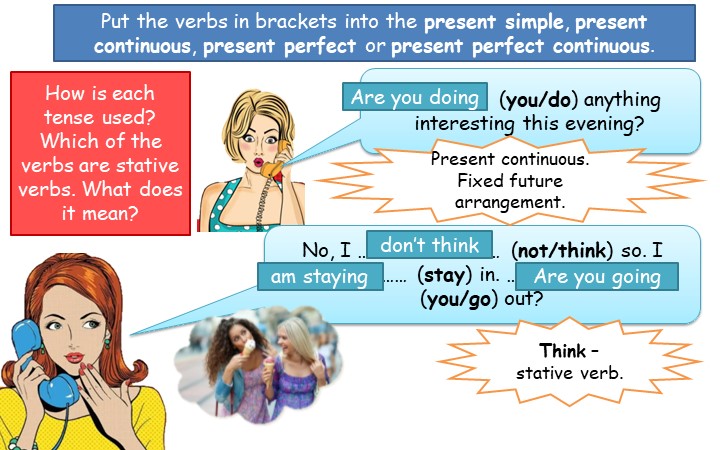
………………… (you/do) anything interesting this evening?
No, I …………………………… (not/think) so. I ………………… (stay) in. …………………………… (you/go) out?
Are you doing
don’t think
am staying
Are you going
Present continuous. Fixed future arrangement.
Think – stative verb.
How is each tense used? Which of the verbs are stative verbs. What does it mean?
Put the verbs in brackets into the present simple, present continuous, present perfect or present perfect continuous.

How long ………………………… (he/know) Kathy?
Since they met at university.
has he known
My friend ……………………… (forget) to buy me something for my birthday.
Never mind.
has forgotten
Present Perfect. State that exists from a point in the past up to now.
Present Perfect. Recent action.

…………………… (you/read) the new Harry Potter book yet?
I ……………………… (read) it now actually.
Have you read
am reading
Present Perfect. Experience.

Why are you in such a hurry?
Because the film ……………………… (start) at 8 o’clock.
starts
Present Simple. Timetable.

We ……………………… (think) of going to Spain for a week.
What …………………… (you/do) for your holidays this summer?
are you doing
are thinking
Thinking – means having the intention to do sth

The weather …………………………… (get) colder since last Monday.
I ……………… (know). It …………………… (get) colder and colder as the days go by.
has been getting
know
is getting
Present Perfect Continuous. An action that started in the past and is still continuing

…………………………… (you/like) tennis?
Yes, I …………………… (be) a member of the local club for years.
Do you like
have been
Present Perfect. State that exists from a point in the past up to now.

I …………………………… (taste) the soup to see if it’s OK.
What ………………………… (you/do)?
are you doing
am tasting
Tasting – having a taste of it to see if it is good..

The room ………………… (smell) awful.
Why …………………… (not/you/open) the window?
smells
don’t you open
Present Simple. Present state.

Ask and answer, as in the example. Use: always, usually, often, sometimes, rarely, seldom, never. How often do you …
go window shopping
go clubbing
go surfing
go dancing
go swimming
go skating
surf the Net
chat online
send emails
watch documentaries
listen to jazz music
How often do you go window surfing?
Not very often. I usually go window shopping once a month.

Use the verbs and the table below to make sentences about yourself.
change
eat out
meet
talk
write
travel
buy
go
read
see
eaten out
met
written
bought
gone
read
saw
I haven’t seen my uncle since 1998.
I haven’t been to beach since last summer.
I haven’t seen my grandparents for a month.
I haven’t written to my pen-friend since last month.
Example

Been OR gone?
She has gone to the shop.
She has been to the shop.
She has been in the shop.
Ушла, еще не вернулась
Была там и вернулась
Ушла и живет там

Been or gone? Complete the sentences.
Ann’s away. She has ……………… to Spain.
We’ve just …………… to the supermarket. Look at what we’ve bought.
Laura has …………… out. She’ll be back in an hour.
Are you going to the gym? No, I’ve already ………….

Look at Ann’s list. Ask and answer questions. Use yet or already.
Has Ann been to the gym yet?
Yes, she’s already been there. Has she had lunch yet?
Yes, she had a sandwich. Has she done the shopping yet?
No, she hasn’t done the shopping yet. Has she fixed her bike yet?
Yes, she has already fixed it. Has she done her housework yet?
No, she hasn’t done it yet. She’s been too busy.
Make a list of things to do today. Swap papers. Ask questions to find out what your partner has already done/hasn’t done yet.

Respond to the questions (1-5). Use just, already or yet.
“How about a sandwich?” “No, thanks. I ……
‘ve just had lunch.”
“Is Jane here?” “I’m afraid not. She …………
has just left.”
“Have you posted the invitations?” “Sorry. I ……………
have not done it yet.
“Is dinner ready?” “Sure. I ………………
have just finished cooking.
“Would you like some coffee?” “No, thanks. I ……………
have already had some.

Ask and answer using for or since.
The ground is wet. (rain)
A: Has it been raining?
B: Yes, for two hours. / Yes, since this morning.
You look tired. (work)
A: Have you been working hard?
B: Yes, since this morning. / Yes, for two hours.

Your clothes are dirty. (play in the garden)
A: Have you been playing in the garden?
B: Yes, for two hours. / Yes, since this morning.
You are sunburnt. (sit in the sun)
A: Have you been sitting in the sun?
B: Yes, since this morning. / Yes, for two hours.

Phrasal verbs: look
Look
after
(take care of)
out for
(be careful)
down on
(think sb is not good enough)
up
(find sth in the list)
forward to
(anticipate)
Смотреть с высока
Искать что-либо в списке, справочнике
Присматривать, заботиться о ком-либо
Думать о, быть острожным с
Ожидать с нетерпением

Match the definition.
Look up
Look forward to
Look down on
Look after
Look out for
Be careful
Find something in the list
Anticipate
Think sb is not good enough
Take care of

Complete.
Look …………………
after
down on
up
forward to
out for

Fill in: forward to, out for, after, down on, up.
1. Don’t tell me that the concert has been cancelled. I was really ……………………………… it.
2. My grandmother …………………… my baby sister while my mother works.
3. When you travel abroad, you should …………………… pickpockets.
4. My cousin is really arrogant. I hate the way he ………………………… everyone.

In teams, make sentences using a phrasal verb LOOK. Each correct sentence gets one point.
I sometimes look after my neighbours’ dog.
I often look up words in the dictionary.
I’m really looking forward to my holidays.

Learn depend prepositions.
good
be careful
be keen
bad
enthusiastic
be careless
at
with
on
at
about
with
Хорошо разбирающийся в чем-либо
Быть аккуратным с
Увлекаться, втянуться
Плохо разбирающийся в чем-либо
Увлекаться чем-либо
Быть небрежным с

Хорошо разбирающийся в чем-либо
Быть аккуратным с
Увлекаться, втянуться
Плохо разбирающийся в чем-либо
Увлекаться чем-либо
Быть небрежным с
Learn depend prepositions.
good at
be careful with
be keen on
bad at
enthusiastic about
be careless with

Complete the paragraph with: at, with, on, about. Use the phrases to make sentences about yourself and your friends.
1.
2.
3.
4.
5.
6.
at
at
with
with
on
about
I’m very good at giving advice, but I’m very bad at receiving it.
I am careful with my possessions an d I expect others not to be careless with my things either.
My brother is keen on football but I am not very enthusiastic about it.

Read the theory box. Form adjectives from the words in brackets to complete sentences (1-4).
A ………………… (dare) and ………………… (honour) superhero who fights crime.
A ………………… (fiction) teenage wizard who has a ……………… (power) enemy.
Two ………………… (comic) cartoon characters who are also ……………… (fear).
An ………………… (excite) story about the adventures of three ……………… (courage) Frenchmen.

Key word transformations
Complete the second sentences so that it means the same as the first. Use the word in bold. Use two to five words.
1. I last travelled abroad two years ago.
been
I ……… two years.
2. I haven’t met him before.
time
It’s the ………… him.
3. He started work in 1999.
working
He ………… 1999.
4. It’s a long time since we ate out.
for
We ………… a long time.
I haven’t been abroad for two years.
It’s the first time I have met him.
He has been working since 1999.
We haven’t eaten out for a long time.

5. I’ve never read such a good story.
best
It’s the ………… read.
It’s the best story I’ve ever read.

Workbook
Mark the tenses with PS (Present Simple), PC (Present Continuous), PPS (Present Perfect Simple), PPC (Present Perfect Continuous). Then match to the correct descriptions.
Fixed arrangement in the near future
Permanent situations/states
Actions taking place at or around the moment of speaking; temporary situations
Actions started in the past and continuing to the present
Changing or developing situations
A past action whose result is visible in the present
Permanent truths or laws of nature
Expressing anger, irritation or criticism
Timetables
Recently completed actions
1. They are moving to Australia this summer.
2. Laura has just finished cooking dinner.
3. Water boils at 100˚C and freezes at 0˚C.
4. The train to London leaves at 12 o’clock.
a - PC
j - PPS
g - PS
i - PS

Fixed arrangement in the near future
Permanent situations/states
Actions taking place at or around the moment of speaking; temporary situations
Actions started in the past and continuing to the present
Changing or developing situations
A past action whose result is visible in the present
Permanent truths or laws of nature
Expressing anger, irritation or criticism
Timetables
Recently completed actions
5. Derek is watching a new DVD now.
6. He’s been reading the magazine all morning.
7. She has had a haircut. It suits her very much.
8. China is becoming more and more powerful.
9. My cousin lives in Wales.
10. My sister is always borrowing my clothes.
c - PC
d - PPC
f - PPS
e - PC
b - PS
h - PC

Put the verbs in brackets into the correct present tense.

Put the verbs in brackets into the present simple or the present continuous.
A: I …………………………… (see) the dentist this afternoon.
B: I …………………………… (see). We can meet tomorrow then.
1
A: Pat ………………………… (enjoy) paragliding.
B: And ………………………… (he/enjoy) his paragliding holiday in Scotland?
2
A: They ………………………… (think) of moving house.
B: I ……………………… (not think) it’s a good idea.
3
A: He ………………………… (have) a new computer game.
B: That’s why he ………………………… (have) problems doing his homework.
4
A: Who’s the girl over there who …………………… (look) at the painting?
B: I’m not sure but she ……………………… (look) very friendly.
5

A: The band ……………………… (appear) on stage next week.
B: Indeed. It ……………………… (appear) that lots of people will attend the concert.
6
A: What ……………………… (you /smell)?
B: These flowers. They just ……………………… (smell) beautiful!
7
A: ……………… this bag of sugar ………………… (weigh) more than that one?
B: Hold on, Mum …………………… (weigh) them now.
8
A: Why ……………………… (he/be) so difficult?
B: Oh, some people ………………… (be) just difficult to get on with.
9
A: Why …………………… (you/taste) the soup? It’s not ready.
B: It ……………………… (taste) too salty. Add some water!
10

Put the verbs in brackets into the present simple, present continuous, present perfect or present perfect continuous.
A: What ……………………………… (you/do) all summer since you got here?
B: I ……………………………… (swim) and ……………………… (cycle) mostly.
A: How long …………………………… (Patrick/work) there?
B: He ………………………… (be) at that company for five years.
A: ………………………… (he/know) how to paraglide?
B: No, but ………………………… (he/learn) to.
A: ………………………………… (she/study) all day?
B: Yes, she ……………………… (sit) exams tomorrow.
A: ………………………… (you/play) this computer game before?
B: Yes, I ……………………………… (play) it every day for the past week.
1
2
3
4
5

Fill in: has/have been to/in or has/have gone to.
How long ……………………… you …………………… Petersburg?
Alistair ……………………… the cinema to see the new Superman film.
I ………………………… that café many times.
My Dad isn’t here. He …………………………… his office.
Sarah still isn’t feeling very well. She …………………………… the doctor twice already.
Mum ……………………… the supermarket this morning.
Dad ……………………… the supermarket. He’ll be back later.
He ………………………… the cinema twice this week.
We …………………… never …………………… this basketball court before.
…………………… you ever ………………… London?

Look at the people in the pictures. Follow the example to ask and answer questions.
A: She looks tired.
B: She is. She’s been training at the gym all morning.
A: She looks annoyed.
B: She is. She’s been trying to send an email for an hour.
A: They look happy.
B: They are. They have been waiting for their exam results for a month.

Fill in: forward to, out for, after, down on, up.
People from the countryside hate it when people from cities …………………………… them.
I’m really ………………………… watching my favourite comedy on TV this evening.
When paragliding, you have to …………………………… strong winds.
Sorry, but I can’t go to the cinema with you tonight as I have to …………………………… my younger brother.
If you need her number I can ……………… it ………… for you in the telephone directly.
look down on
looking forward to
look out for
look after
look
up

Fill in: at (2), with, on, about.
His parents are not keen …………… him going on holiday on his own.
My best friend is not very good …………… horse riding.
Sean is very careless …………… his things. He keeps losing them.
My grandmother is very creative and is enthusiastic ………… surfing the Net.
My brother loves eating, but he’s hopeless ………… cooking.
on
at
with
about
at

